
Poland's Divide Is Real, Just Not Where People Think – latest NCF study shows
Ask people in Poland how divided their country is and most will describe a deep and dangerous rift. Ask the same people where they personally stand on the key social and political issues in the country, and the picture softens: the gaps are moderate, and on most questions Poles have far more common ground than anyone expects. That distance – between the how citizens perceive their society and how divided they actually are – is the central finding of "The State of Polarization 2026."
Our study
The State of Polarization ("Stan polaryzacji") is Poland's first comprehensive, systematic study of social division. It is produced by the New Community Foundation (NCF), a Polish non-profit that runs practical programs to address polarization, together with USWPS, Poland’s largest private university and leading school of psychology in Central Europe. Now in its second annual edition, the study provides a scientific foundation for tools and solutions to polarization – which the NCF tests in Poland and shares with non-profits from other countries.
The 2026 edition surveyed a representative sample of 2,040 adults in May 2026, with the survey run online by the Pollster research institute. The first edition was fielded a year earlier, in May 2025, with data collected directly before Poland’s presidential election. 2026 is a non-election year, hence latest results are less impacted by current political developments.
The findings at a glance
Poles broadly agree on what matters most – regardless of party. The top concerns in 2026 are access to doctors and hospitals, the cost of living and wages, and the threat from Russia.
Ideological polarization is moderate. None of the thirteen most important issues splits the country into strong opposing camps. Abortion divides Poles most; judicial independence least. There is real room for agreement.
Affective polarization is strong. Poles attribute negative traits to those who disagree with them about four times more often than to those who agree. Most feel some dislike toward the other side; 22% feel strong dislike.
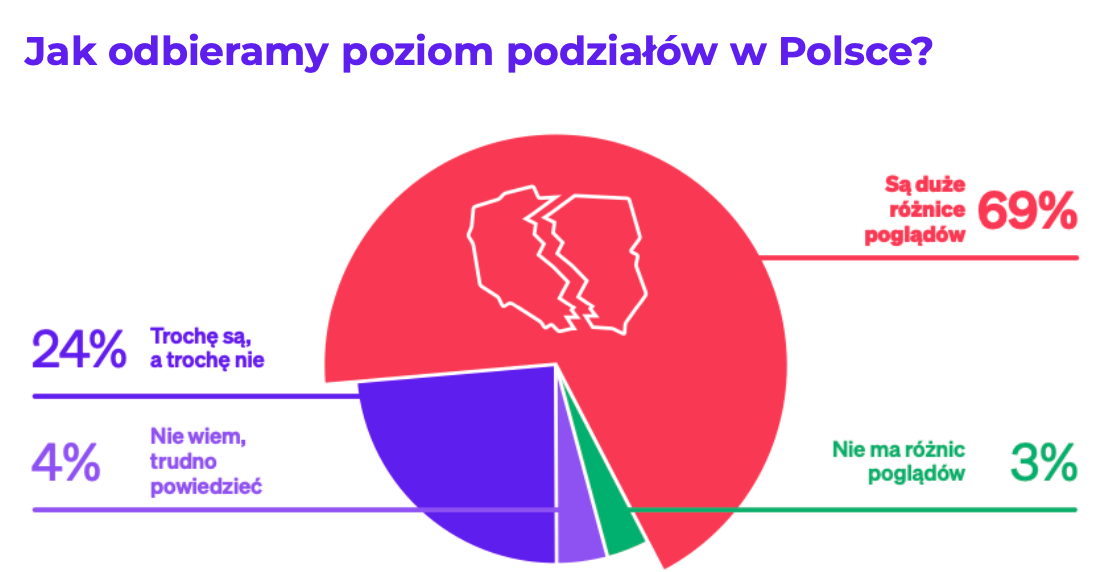
Perceived polarization is strong. 69% see large differences of opinion, though the measured differences are moderate. They want – and actually have – a society with a strong center, yet many can't see it, most likely because political and media discourse keeps amplifying conflict.
The divide leaves a private mark. Over half of Poles say it stresses them; around 15% report a damaged relationship. Polarization shows up less as open conflict than as silence: more than half avoid talking politics at all.
To keep the study grounded in what citizens themselves care about – rather than what politicians, pundits or the media emphasize – our researchers first asked a separate sample which issues feel most important right now, then measured polarization only on those. The 2026 list runs from healthcare access and the cost of living to the threat from Russia, abortion, free speech, and the everyday coexistence of Poles and Ukrainians in the contry.
Three kinds of polarization
The yearly study tracks three different types of polarization:
Ideological polarization – how far apart people's actual opinions are on the issues.
Affective polarization – how much dislike people feel toward those who hold different views.
Perceived polarization – how divided people believe their society to be, regardless of the reality.
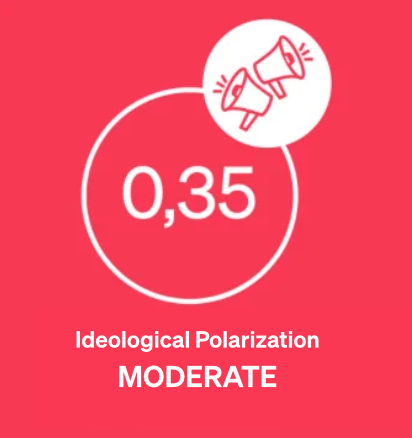
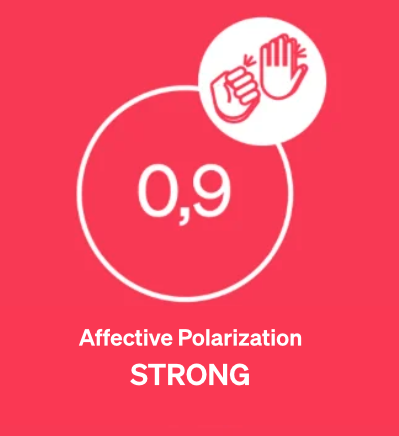
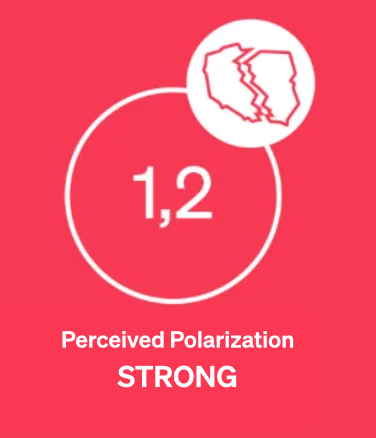
Poland in 2026 scores moderate on the first, strong on the second and third. Keeping these apart is what makes the results legible – and it is where most public commentary goes wrong, collapsing three separate phenomena into a single alarming word.
Poles agree on the problems – and rarely occupy opposing camps
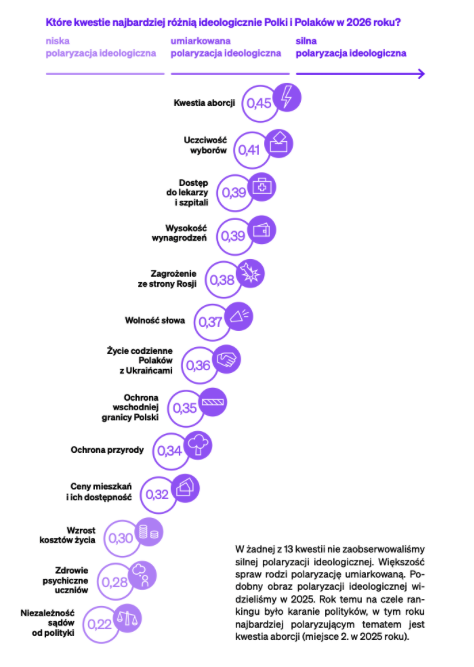
Across party lines, Poles broadly agree on what matters most in 2026: access to doctors and hospitals, the cost of living and wages, and the threat posed by Russia. This holds for supporters of both main political blocs – the national-conservative Law and Justice (PiS) and the liberal-centrist Civic Coalition (KO) – even if economic worries weigh a little more heavily on one side and security on the other.
On the issues themselves, division is more muted than the national mood suggests. Of the 13 most important issues, not one splits the citizens into strong opposing camps. Abortion is the most divisive – and even there the polarization index reaches only a moderate level – while judicial independence is the least, a question on which Poles largely agree. A striking share of respondents cluster in the middle of the scale rather than at the extremes, pointing to genuine room for compromise in Poland.
The dislike is real
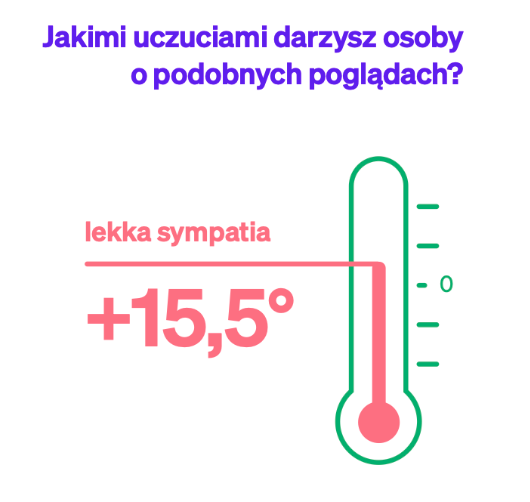
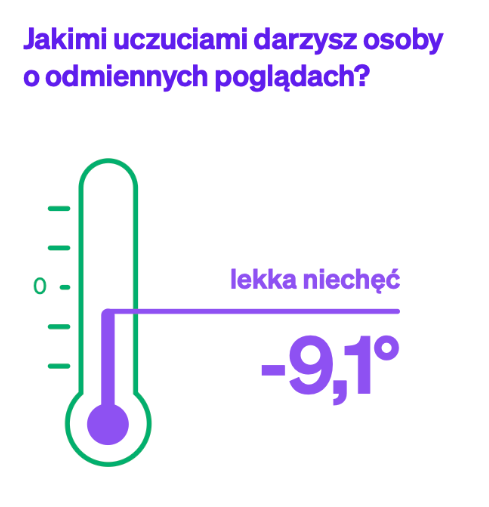
Where the country does look polarized is emotional. Poles attribute negative traits – less intelligent, less honest, worse at understanding the world and politics, less likeable – to people who disagree with them roughly four times more often than to people who share their views. Around sixty percent report negative feelings toward those on the other side, and about one in five – 22% – report strong dislike.
The perception gap
Here is the finding that should give any observer pause. Sixty-nine percent of Poles believe their society is marked by large differences of opinion – yet the measured differences are only moderate. Asked to choose a picture that best represents Polish society, respondents split evenly between an image of a country cleaved into two hostile camps and an image of a society dominated by a moderate center. Asked what they would want, the strong center wins easily. And by the study's own measurement, the strong center is what Poland actually has.
So Poles want a moderate, broadly centrist society; they largely have one; and yet a large share cannot see it – most likely, the researchers suggest, because political and media discourse continually amplifies conflict. When asked who is most responsible for setting Poles against one another, respondents point first to politicians in general (43%), and blame the other side's politicians (33%) far more readily than their own (5%). Traditional media and disinformation feature heavily too. Notably, 68% want politicians to work at reducing divisions rather than stoking them.
A quiet cost
Polarization in Poland shows up less as open confrontation than as silence and distance. Over half of respondents say the country's divisions are a genuine source of stress; around 15% report that their relationships with people close to them have suffered. More than half avoid talking about politics altogether, a third hide their views to protect their relationships, and a third never discuss politics with anyone who disagrees with them. When Poles do choose to talk across the divide, their most common goal is to understand the other person's point of view – not to win.
One year on, with a caveat
Compared with 2025, affective polarization looks noticeably higher. The researchers are careful not to over-read this: because the two editions used different samples and different survey providers, it is not yet possible to say whether this reflects a real rise in hostility or an artifact of method. Establishing genuine trends is precisely why the study is designed to repeat, year after year.
Why it travels beyond Poland
Poland's case is a clean illustration of a pattern researchers are documenting across many democracies: societies can grow to dislike one another intensely without actually disagreeing much – and can convince themselves they are far more divided than the evidence supports. If the deepest problem is perception rather than substance, then part of the remedy is informational: showing people how much they already share, and how much of the "war" they picture is a story told to them rather than a fact about their neighbors.
The full report, along with the underlying data on all three dimensions, is available from the New Community Foundation.